


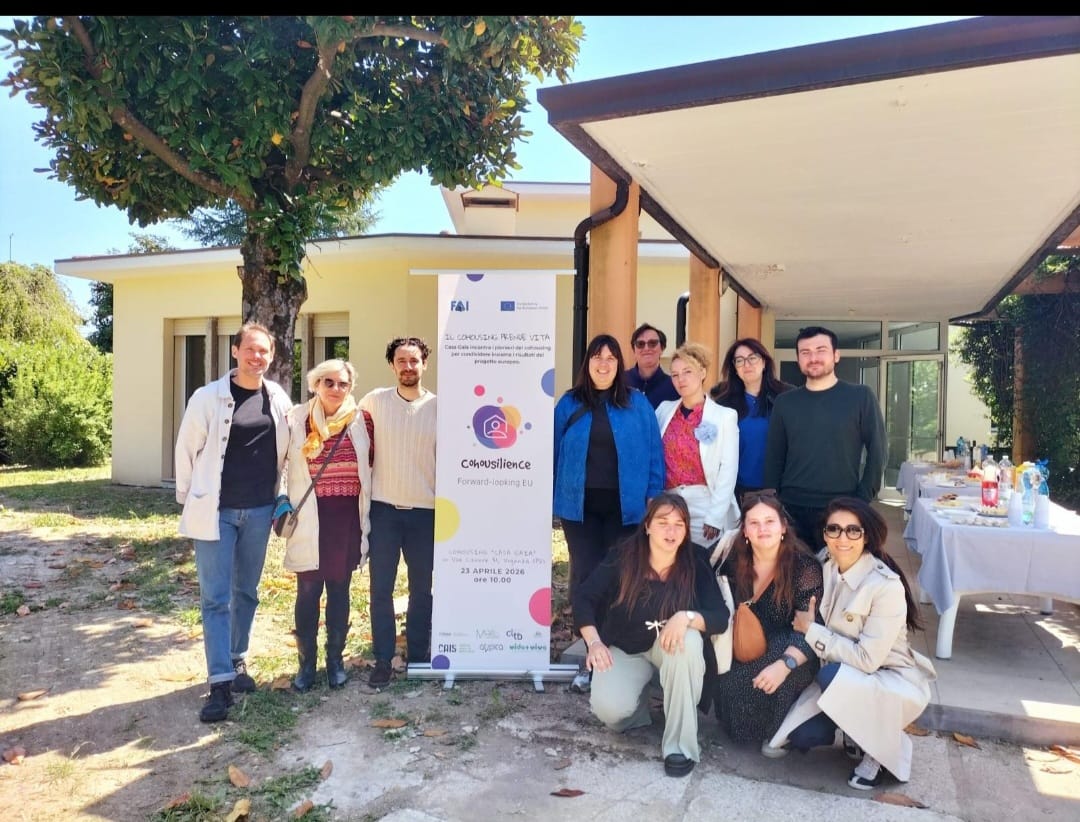
Cohousing Comes to Life: Great Success for the Cohousilience Final Event at Casa Gaia
- Meeting the creators: Participants talked with the minds and hearts behind the project.
- Guided tour: Attendees explored the spaces of Casa Gaia at via Cavour 31.
- New community hub: The building revealed itself as a vibrant center open to the local area.
- International exchange: European partners enriched the debate with perspectives and best practices from across Europe.


Best Cohousing Practices in the World!


3^ LOCAL MEETING - MDAT
Financing, Partnerships, and Cooperative Housing Ecosystems: A Closer Look at the Turin Case and Beyond
A recent event sparked an engaging and insightful discussion around cooperative housing, drawing significant interest—particularly regarding the growing and dynamic ecosystem currently taking shape in the city of Turin. The meeting provided an opportunity to explore various models and approaches to social housing, with a special focus on the policies and tools implemented by the Municipality of Turin.
What clearly emerged is that Turin stands out as a fertile ground for social housing and, more specifically, cohousing initiatives. The city hosts a rich and diverse ecosystem, where numerous cooperatives actively collaborate with public authorities, third-sector organizations, and citizens to promote inclusive, sustainable, and community-driven housing solutions.
What makes the Turin experience especially noteworthy is the synergy between public initiative and civic engagement, which has led to the development of innovative forms of collaborative living. This model offers valuable insights and inspiration for other urban contexts—both in Italy and across Europe.
Another key takeaway from the discussion is the growing interest in cooperative housing from other cities and regions, including Thessaloniki and Athens. In Greece, in particular, a network of NGOs, municipalities, and civil society actors is emerging around the need to establish a stronger national legal framework that supports the development of social and cooperative housing. The lack of appropriate legal tools is seen as a significant barrier to the emergence and long-term sustainability of cohousing projects—despite a clear and growing demand among citizens.
In this context, the Turin model serves not only as a source of inspiration and a replicable example, but also as a springboard for a broader reflection on how to strengthen housing policies through public-private partnerships, dedicated financial instruments, and a clear and stable legal framework.
The challenge ahead is twofold: on one hand, continuing to nurture and reinforce local ecosystems like the one in Turin; on the other, promoting a shared vision at the national and European levels, one that recognizes cooperative housing as a concrete and viable response to today’s housing needs.


3^ LOCAL MEETING - COOP FAI PADOVA
On Wednesday, May 28th, FAI Padova Cooperative held an inspiring new chapter of the “Cohousilience” project, with an experiential workshop focused on conflict management and shared decision-making in co-housing. The meeting was led by Ilaria Locati – psychotherapist, group analyst, and COIRAG trainer – and aimed at exploring how to recognize and address conflict in shared living, practical tools for managing diversity, daily governance and decision-making processes. A heartfelt thank you to all participants for their openness, curiosity, and commitment!

2^ LOCAL MEETING - COOP FAI PADOVA

1^ LOCAL MEETING - COOP FAI PADOVA

STUDY VISIT IMPACT - "Inspired by Diversity"
 Lut Verstappen – communications officer Odisee – Centre for Family Studies

Target groups of Cohousilience
TARGET GROUPS OF COHOUSILIENCE🎯
Cohousilience has three main target groups that act as direct and indirect beneficiaries of different activities respectively.
1️⃣.The first main target group is composed of fragile people at risk of social exclusion (cohousers). Among those, two groups are identified and selected: migrants and elderly people (>65 years old) due to the particular economic, social, cultural and health challenges. These individuals are the cohousers of the partners’ housing projects in Belgium, France, Italy and Greece, beneficiaries who will be involved in “Cohousilience” directly and indirectly.
2️⃣.The second main target group is composed by social workers, educators and other professional staff of the partners dealing with related topics (social innovation, housing, welfare policies), who have experience in the design and implementation of cohousing projects and are involved in project activities such as peer-to-peer education and training (Work Package 3:study visits) and pilot development and implementation in the other two Work Package.
3️⃣.Finally, the third group that will benefit directly and indirectly from the project is the community, such as a wide congregation made up of local stakeholders (including third sector organizations and institutions, NGOs etc. ) and citizens.

3rd Study Visit in Brussels, Belgium
Following our second Cohousilience study visit on May 27-29 in Paris, we are now ready for our third study visit next week in Brussels, Belgium!
Our partner, CLTB (https://www.cltb.be/?lang=en), from Brussels is going to host the visit to exchange knowledge and share best practices on cohousing with our other European partners.
We are going to study CLTB’s cohousing model and their CALICO project, visit their network in the neighborhood and have some training sessions on the following topics presented by our Spanish partner, CAIS:
- Codesign
- Energy and bioclimatic
- Spaces and uses

Cohousilience: Kick-off and First Transnational Meeting
We are glad to announce that the kick-off meeting and the first transnational study visit of our Erasmus+ project, "Cohousilience: developing cohousing in the EU for forward-looking societies" was held from March 4th to 6th, 2024 in Turin, Italy.
Our partner organizations from six European countries took part in this event to celebrate the project opening and visit the first cohousing establishment called “Luoghi Comuni'' run by Cooperativa Sociale Atypica ARL in Turin, Italy.
The participating partners were: FAI Padova (Padova, Italy), Cooperativa Sociale Atypica ARL (Turin, Italy), Anaptyxiaki Meizonos Astikis Thessalonikis Ae - Anaptyxiakos Organismos Topikis Autodioikisis (MDAT) (Greece), Odisee (Belgium), Community Land Trust Bruxelles (Belgium), Consorcio Andaluz De Impulso Social Community (CAIS) (Spain), Association Caracol (France), and Associacao Animam Viventem (Portugal) (Online).
We are now preparing for the second transnational study visit on May 27-29 in Paris, France.